Week_06:
Interdisciplinary insights;New approaches and creative partnerships
Lecture notes:
In her interview with Louize Harries, Susanna had covered a broad range of topics pertaining to the subject of collaboration and had touched on several points that had provided a link to the material, that I had referenced in previous weeks. Least among them, the importance of the Black Mountain college and the pioneering curriculum that had been explored there, during the 1960’s.
One of the key figures to come out of this progressive school was none other than, Robert Rauschenberg, whose own collaboration with Willem De Kooning had formed the basis for my assignment, in week 05.
As the lecture progressed I was encouraged to discover further references to some of the key figures in the history of interdisciplinary design practice, one of whom was a figure that I had long admired. Buckminster-Fuller would play a formative role in the re-defining of the American landscape and go on to influence generations of Designers, Architects, Inventors, Scientists, Artists, and Engineers. His legacy is far reaching and his pioneering exploration of interdisciplinary practice had led to the creation of the Geodesic Dome, which would subsequently be deployed as a solution in the housing of victims, of natural disasters. The Geodesic Dome is cited as one of the great works to emerge from the Think Tank, that had been overseen by Buckminster-Fuller. And has since contributed to the saving of millions of lives, around the globe.
As the 21st Century begins the role of design-thinking as a tool is once again at the centre of the conversation: With the emergence of new areas of design practice such as Service Design and Speculative Design becoming more relevant, in today’s landscape. These industries in particular, have in recent years demonstrated a renewed interest in the use of collaboration as a tool. Indeed, much of their respective practice is built on a cross industry strategy, and seeks to utilise the expertise of external parties. The outcome of this comprehensive approach is a level of insight and response, that has perhaps been lacking in much of the industry, in the years since the 1960’s.
So, let us take a moment to reflect on the role of interdisciplinary practice and how this relates to the value of collaboration.
Louize’s project examined the issue of air-pollution in London using scientific data. Louize conceived of a strategy that had sought to align the discussion around climate change with the narratives that are to be found in the bible, and in-so-doing, provide a context in which she could implement her solution. Using a drone and working alongside experts in the field of medicine, Louize had devised a design strategy that had allowed her to make an otherwise invisible threat, visible to the wider public. The implementation of this solution would utilise both bacteria and algae spores to stimulate rainfall, and in the process infuse the rain with a red dye, in order to create a visual presentation, that demonstrated the full scale of the threat to the environment.
In this example the creator has endeavoured to highlight an important environmental issue through a collaboration with experts in fields, outside of the creative industries. The subsequent outcome of this collaborative partnership was a design solution that was grounded in scientific reasoning and rich in conceptual thinking. Such projects allow the public to digest complex data-sets that may otherwise elude the average member of the public.
A proof of concept, and those projects that are focused on speculative design, are important to the conversation because they highlight the crux of an issue and provide different perspectives, through which to analyse a problem. Therefore, it is important that such endeavours take into account all parties, specifically the users. Such partnerships have the potential to enrich society, providing insight and education on subjects that may at first seem removed or unrelated, to their own respective practice or profession. Therefore, it is important for all industries to remain receptive to the notion of interdisciplinary collaboration, and to work together for the greater good of the collective society.
As we had previously observed in our investigations into Ethnographic research, the collaborative partnership is not limited to the creator and their peers. For in order for a collaboration to be fully inclusive, and therefore comprehensive in its observations, it should also view the role of the user as important to the collaboration. This same attentive diligence can also be applied to the environments in which the project is to be implemented, as was the case with Unknown Field’s short-film, Unravelled: A procession through the hidden landscapes of fast fashion. In this production, the literal landscape can be viewed as a collaborator, providing both context and commentary, for the viewer’s benefit.
Research
Unknown Fields:
Unravelled: A procession through the hidden landscapes of fast fashion.
Workshop Challenge
The Challenge
What are the advantages of interdisciplinary provocation and how could you utilise this approach in your practice
Put theory into practice and spend an hour brainstorming ideas based on the following challenge and who you would choose to work with.
Identify a discipline and specialist who could help you to reflect from a dynamically opposing position on a specific problem.
Pick one of the issues below and discuss with your chosen individual how you may solve the challenge. This should ideally be recorded as an audio podcast. Our interest in this also relates to the way in which different disciplines discuss an issue and their manner and approach in communicating differently, as well as how you would capture this.
As a guide, please evolve your own strategy for bridging the questions. Equally, you may wish to also consider the core issues: how would your specialism solve this and how different is this to the expected design thinker?
Do not forget to consider the communication style you would use to encourage interdisciplinary dialogue.
Finally, how do you summarise these findings in a way that is acceptable to both collaborators.
Improving mental health in young adults.
Reducing pollution in inner cities.
Encouraging greater engagement with galleries and museums.
Reducing isolation and loneliness.
Promoting greater community cohesion.
Brainstorm
Tutorial
Prior to this week’s tutorial, I had found myself somewhat, conflicted as to which direction I should take, in regards to the proposed avenues of investigation. Therefore, it was my intention to resolve the issue by engaging in further discussion with Alec, having already touched on some of the proposed subjects in the previous weeks’ Webinar.
Having already spent some time exploring the subject of mental health in Module 04, I had made the decision not to include the topic in my deliberations, and so I had moved swiftly on to the next subject on the list, that had piqued my interest, that being the encouraging greater engagement with galleries and museums.
The discussion then turned to the role of technological innovation, in the delivery of content. With several examples of case-studies, being put forward by Alec. We explored the definition of a museum and gallery space, and what criteria has to be satisfied in order operate successfully, in these sectors. The conversation was further stimulated by the consideration of current events, and by contemplating the challenges that pose a threat to our national institutions, as a consequence of the Covid 19 outbreak.
In conclusion, the tutorial had proved to be of considerable benefit to my deliberations, and I had left the meeting feeling a greater sense of clarity and with a more defined route, going forward.
Podcast
Preparation
Having defined the direction of my response to this week’s task I had then set to making a list of the institutions, that I believe to be suitable candidates for partaking in the interview.
The National Gallery
Serpentine Galleries
Whitechapel Gallery
Tate
Saatchi Gallery
Dia (Visual Design agency, NY)
Email Correspondence
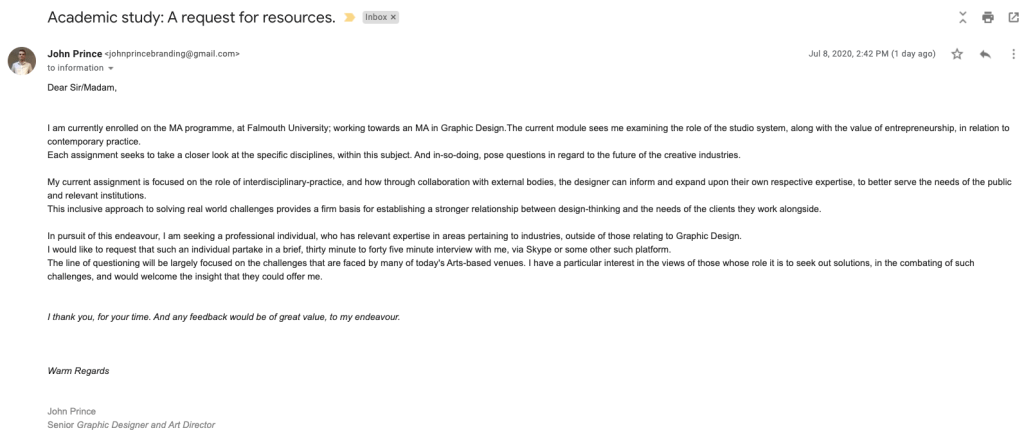
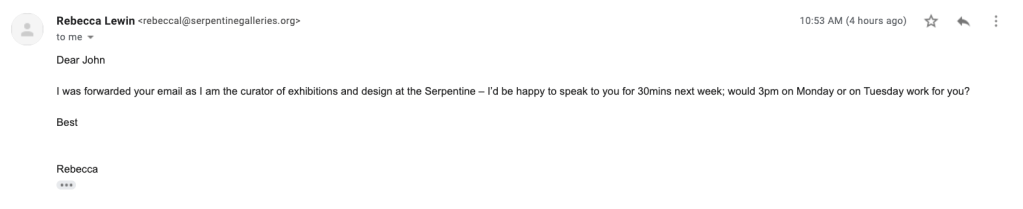
Factoring in the current challenges that have been created as a consequence of the Covid 19 pandemic, I had anticipated receiving a number of rejections, and indeed this had been the case, in many instances. However, I did receive a reply from the Curator of Exhibitions and Design, at the Serpentine gallery.
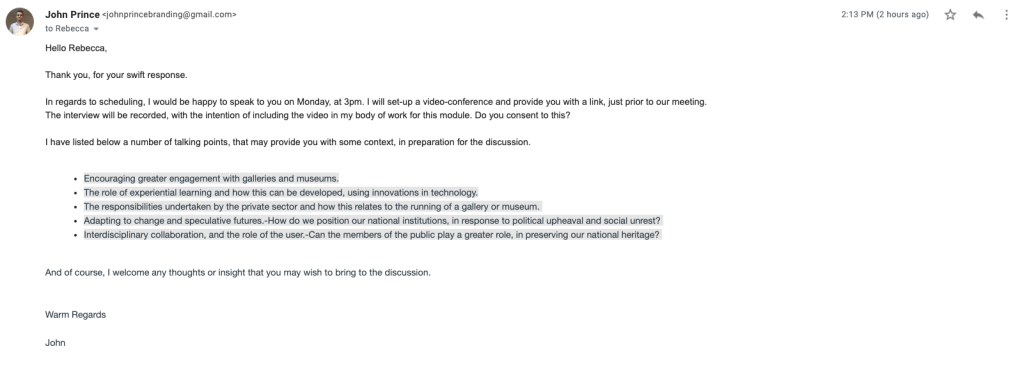
In the below screenshots, I have documented our correspondence:

Interview
In preparation for my interview with Rebecca Lewin, I had begun to contemplate the subjects around which I would structure the discussion, taking care to select points that would be relevant to both the Serpentine and this week’s assignment.
Talking points
Encouraging greater engagement with galleries and museums.
The role of experiential learning and how this can be developed, using innovations in technology.
The responsibilities undertaken by the private sector and how this relates to the running of a gallery or museum.
Adapting to change and speculative futures.-How do we position our national institutions, in response to political upheaval and social unrest?
Interdisciplinary collaboration and the role of the user.-Can the members of the public play a greater role, in preserving our national heritage?
Extrapolating points of interest from the above topics, I had then begun to distill my line of inquiry into a succinct set of questions, with the aim of maximising the efficiency of my strategy and managing the thirty minutes afforded, to me.
Questions
Q1: With the emergence of new technology driving consumer engagement, and the increasing use of gamification in the deliverance of content, is there a need for galleries and museums to incorporate experiential learning into their exhibits, on a much broader scale?
Q2: How can our national institutions work with the private sector, in order to provide a more comprehensive experience for the public?
Q3: In adapting to the current societal issues and political upheaval, specifically in response to organisations such as Black lives matter or the MeToo movement, how can an institute such as the Serpentine adapt to better represent the changes, taking place in society?
Q4: This year, the Serpentine celebrates its’ 50th anniversary, how has the organisation managed to stay relevant? And how does that success continue, going forward?
Outcome: Interview with Rebecca Lewin, Curator of Exhibitions and Design at the Serpentine Gallery.
Findings & Analysis:
Context and Framing the conversation:
At the beginning of the conversation, Rebecca and I, explore the day-to-day responsibilities that accompany her position, and we discuss the challenges affiliated with staging a new, and relevant, exhibition. We explore how that process begins, with the establishing of a context, that can accommodate the positioning of the exhibition and the content, therein. And how, as a Curator, it is Rebecca’s responsibility to listen to the responses coming from those whom had visited an exhibition at the Serpentine, and to reflect on how the presentation
“Each project is unique, and therefore there will be an element of adaptation to consider.” -Rebecca Lewin, Curator of Exhibitions and Design, Serpentine Gallery.
In the current political climate, and faced with an increasingly unstable societal landscape, it is important for the gallery to provide their visitors with experiences that reflect the conversations taking place, in the public forum. Therefore, how Rebecca chooses to position an exhibition, and the context in which the work is framed, will have a formative impact on the overall success of the programme.
“It is the role of the institution to support thinking that triggers new forms of imagination, or new ideas of how we can live in the world, or how society operates” -Rebecca Lewin, Curator of Exhibitions and Design, Serpentine Gallery.
Following-up on this point, Rebecca asserts that although the gallery does have a role to play in the addressing of such issues, it is not their responsibility to respond to act as an advocate for a particular political philosophy or engage with specific viewpoints, that do emerge from the civil unrest. And her view is, that the gallery should serve as a space in which such dialogues can take place, if those discussions are relevant to the work of the artists, that are showing at the gallery. She adds, that galleries had always been spaces in which such important conversations can take place, however, the galleries should reserve the right to choose how, and if, they want to engage with a particular subject, or not.
Feedback loop: Test; Analyse; And Respond.
Work within the infrastructure available. Challenges can lead to the identification of innovations, in the professional practice.
The role of Technology in relation to the traditional values, of the Gallery.
Technology and Innovation should be led by the work, and if it is relevant to the content, and viable for the user and the gallery, then it could be integrated into an exhibition. On further discussion, Rebecca does express a concern that in her role as a curator, she is reticent to the idea of technology being implemented into an exhibition, in place of relevant content, and that technology should not be viewed as a solution to all of the problems faced, when constructing an exhibition.
Group Discussion

Bibliography
Serpentine, (2020). Hito Steyerl: Actual Reality OS. [online] Serpentinegalleries.org. Available at: https://www.serpentinegalleries.org/whats-on/hito-steyerl-actual-reality-os/ [Accessed 7 July. 2020].
Last name, First initial (Year published). Page title. [online] Website name. Available at: URL [Accessed Day Mo. Year].
 JohnPrinceBranding